Jack Repp
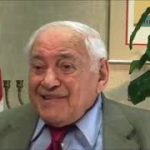 Jack Repp
Interviewed by Paul Lake in 2008 and again by Scott Farber in 2014.
Jack Repp
Interviewed by Paul Lake in 2008 and again by Scott Farber in 2014.
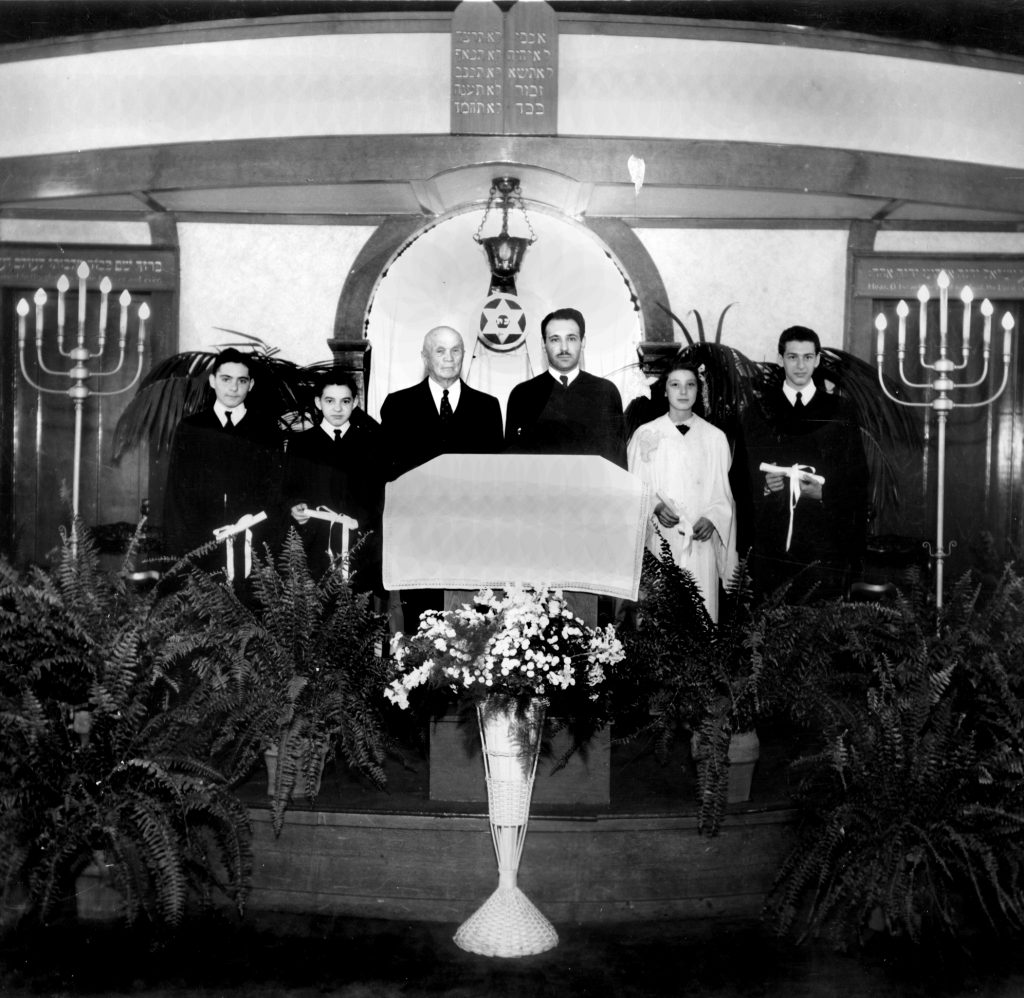
Confirmation class at Temple Emeth, June 24, 1940. (from left to right) Hardy Soloman Fr., Manfreed Schmidt, Sam Doube, Rabbi Smauel Soskin, Ellie Myers, and William Strasmick. Photo taken by Fonville Studios, Ardmore, OK Photo courtesy of The Sherwin Miller Museum of Jewish Art, Tulsa, OK.
When we are approached regarding a donation—as a local historical society, it happens often—the main question we ask is: “does this fit our scope?”—meaning we do our due diligence to make sure that our repository is the best fit for the materials. There are a number of factors that go into making that decision, including, but not limited to:
And, we give the same level of care and consideration to every item and inquiry.
So, when Ruth Andres—a founding member and past President of Dallas Jewish Historical Society—reached out to us concerning a few items that belonged to Clint Risner (of blessed memory), we agreed to assess his collection.
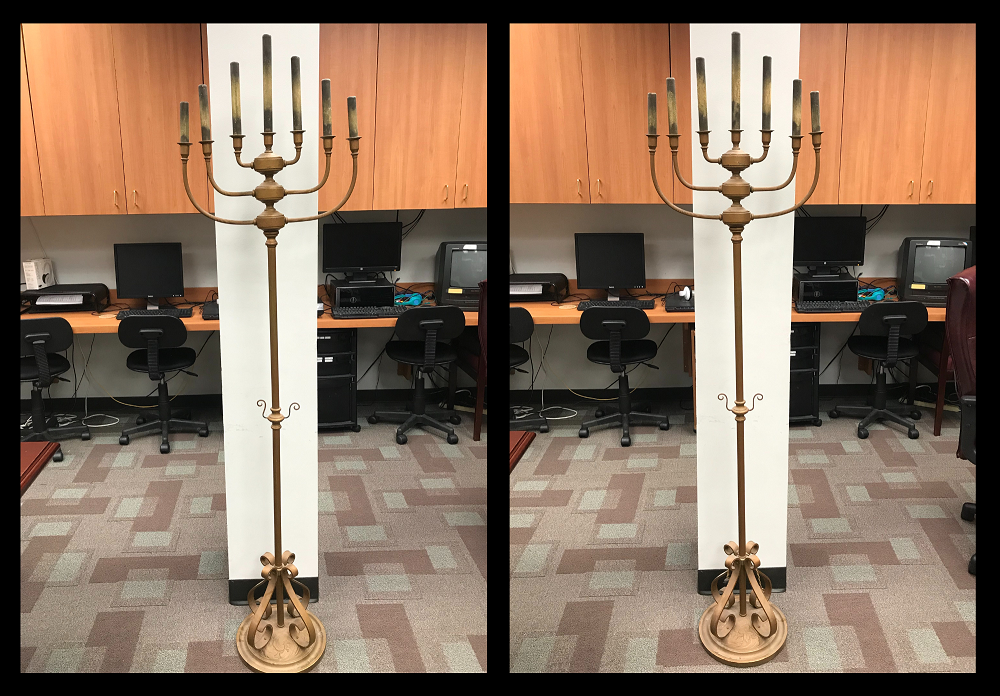
Clint was an active and dedicated DJHS Board Member and oral history interviewer for many years, who also had a deep love of Judaica and local/regional history. That passion led him to acquire a pair of six-foot tall electric menorahs that originally belonged to Temple Emeth in Ardmore, Oklahoma, after the temple closed in 2004.
Temple Emeth was established in 1907 following formal settlement of the Jewish community in Ardmore in 1890. We are able to confirm that the menorahs were present in the Temple in 1940, as witnessed by the photograph (above) of a Confirmation Class at Temple Emeth. (Photo courtesy of The Sherwin Miller Museum of Jewish Art, Tulsa, OK).
We knew upon hearing the history of the items and of the Temple that the menorahs needed to go to a Jewish museum in Oklahoma. The stars aligned when we contacted The Sherwin Miller Museum of Jewish Art in Tulsa, OK, which holds a collection of other items from Temple Emeth as well. We are thrilled to assist in the donation of these items; working with other regional organizations to ensure that collections are thoughtfully and accurately shaped is critical to effective Archive management and public access.
Transport has been arranged to get the menorahs to their permanent home, reunited with other pieces of Oklahoma Jewish history.
 Rusty Cooper
Interviewed by Liz Faeder on July 11, 2018.
Click here to watch the video.
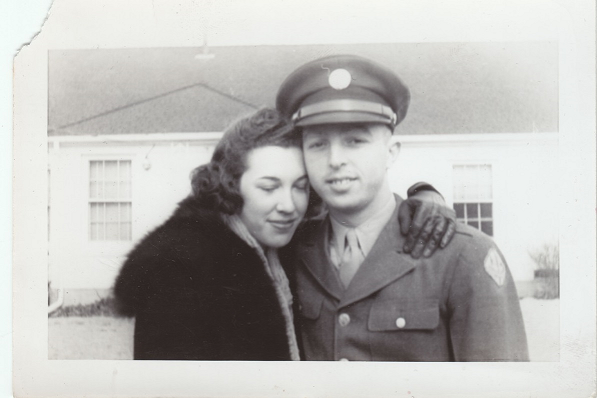
Ellis Titche and May Levy met in Dallas on August 28, 1943, when he was on a weekend pass from school in College Station, TX. Ellis initially connected with Mr. & Mrs. Levy on a previous trip to Dallas, at the request of his father who was a cousin of Mr. Levy.
From the time of the first letter, from May to Ellis inviting him to visit, in the Summer of 1943 (at the request of her mother), the two exchanged correspondence almost daily for over three years while Ellis was in school, training with the military, or overseas fighting in World War II. During this time, they got engaged, were married, and had a child.
We are fortunate to hold within our collection, a large percentage of the original letters. As primary source documents, they detail experiences from training and war camps, societal trends and expectations, and the “average” life of a wartime bride and her beloved.
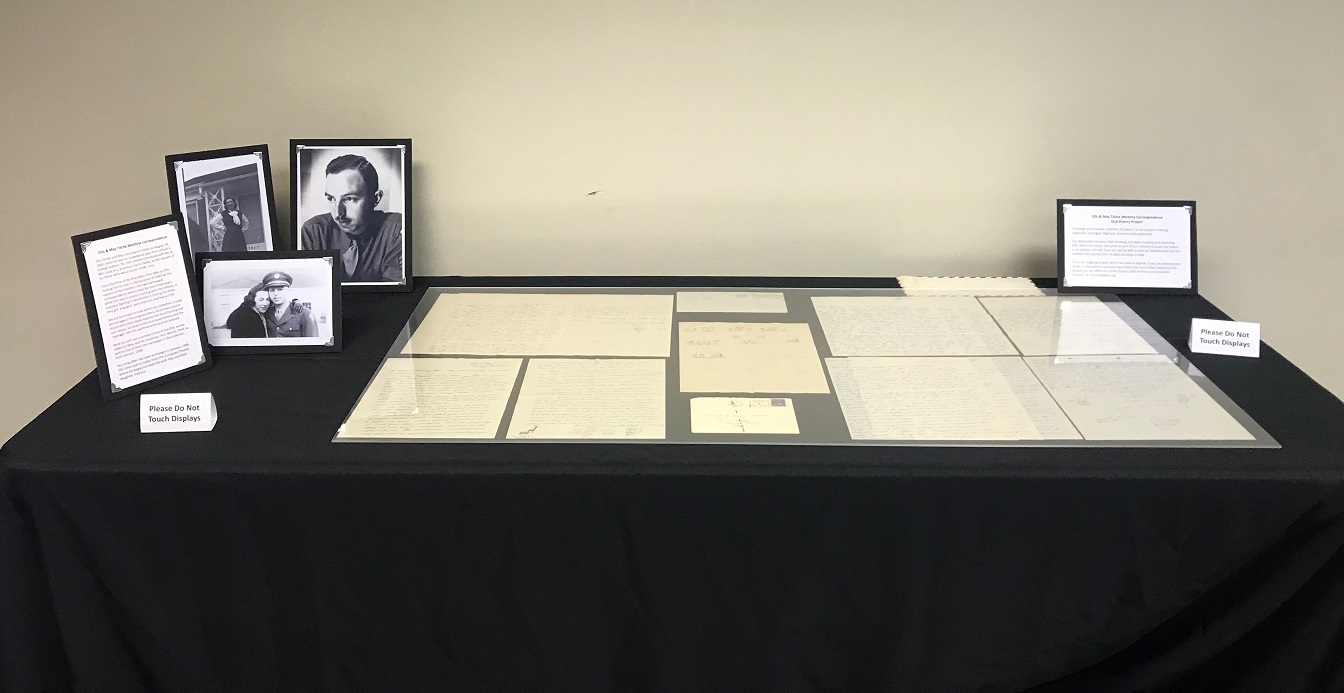
Here you will see a sample of one of the Ellis’ earlier letters to May and her response, from March, 1944, as well as one of their last exchanges in the collection, from January, 1946.
Not long after the later exchanges in January, 1946 Ellis returned to Dallas from the European Theater, where he began his daily life with May and their daughter, Patricia.
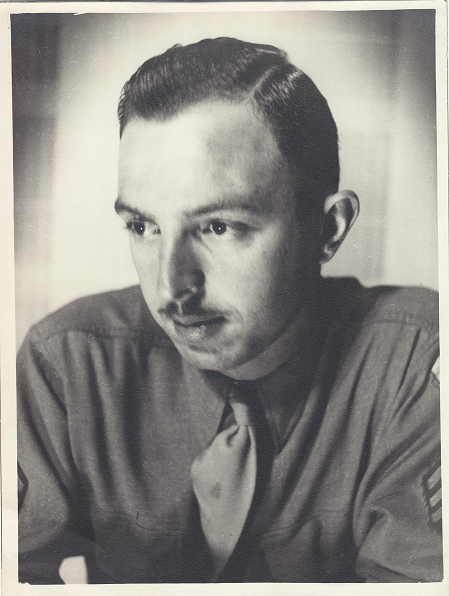
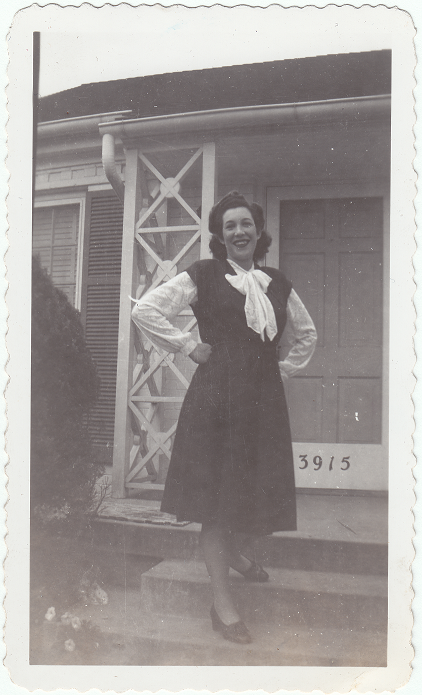
Ellis & May Titche Wartime Correspondence Oral History Project
This large and valuable collection of letters is in the process of being organized, cataloged, digitized, and eventually published.
Our dedicated volunteer, Mel Ginsburg, has been studying and recording Ellis’ letters for nearly two years as part of our initiative to share the letters in an auditory format. Soon you will be able to visit our website and hear the emotion Ellis poured into his daily pennings to May.
This is an ongoing project, which we hope to expand. If you, or someone you know, is interested in volunteering to read and record May’s letters to Ellis, please visit our office or contact Jessica, DJHS Archivist and Volunteer Director, at archivist@djhs.org
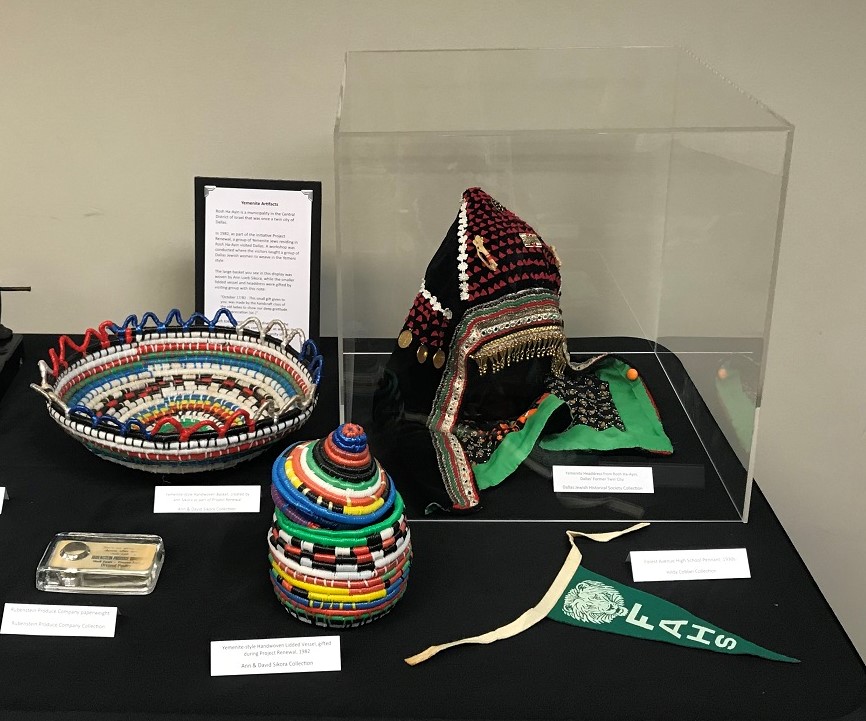
Rosh Ha-Ayin is a municipality in the Central District of Israel that was once a twin city of Dallas.
In 1982, as part of the initiative Project Renewal, a group of Yemenite Jews residing in Rosh Ha-Ayin visited Dallas. A workshop was conducted where the visitors taught a group of Dallas Jewish women to weave in the Yemeni style.
The large basket you see was woven by Ann Loeb Sikora, while the smaller lidded vessel and headdress were gifted by the visiting group with this note:
“October 17/82 – This small gift given to you, was made by the handcraft class of the old ladies to show our deep gratitude and appreciation [sic.]”
Such tokens represent the diversity of the international Jewish community, as well as the connection, kindness, and humanity shared among the diaspora.
Recent Comments